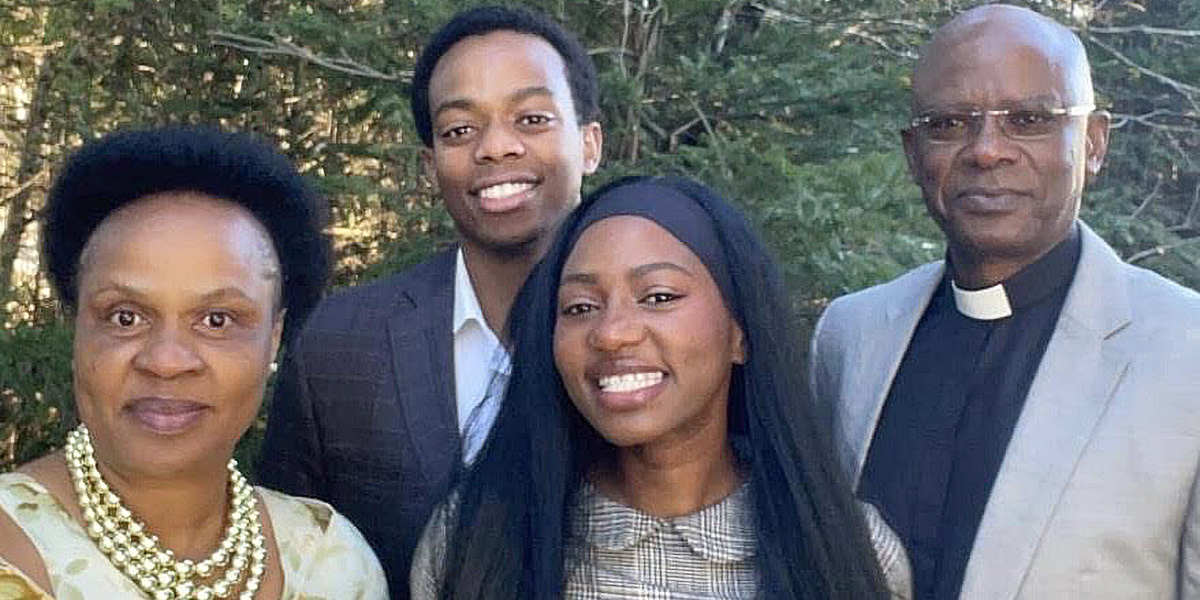
Caleb Twinamatsiko is an Anglican priest and educator from Uganda currently serving as Rector of Christ Church Pennfield in the Diocese of Fredericton in New Brunswick. On Oct. 30 the House of Bishops for the Church of Uganda elected Canon Twinamatsiko as the second Bishop of North West Ankole Diocese. Twinamatsiko, 57, will be consecrated on Feb. 7 at St Paul's Cathedral in Ibanda. Sue Carelessspoke with him about his life in Uganda and Canada.
Can you tell me a bit about your childhood and youth?
I was born on April 16, 1969, in Kigando, Igorora Town Council, Ibanda District, Uganda, and grew up in rural western Uganda. My father passed away when I was 13, but my uncle, Bishop Emeritus Yoramu Bamunoba, took me in and helped shape the person I am today. I completed my primary education at Nkondo Primary School and my secondary education at Masheruka Secondary School before pursuing A-level studies at Bishop McAllister College.
I became involved in church life at the age of fourteen. I sang in the choir, encouraged other young people to participate and led small community projects. A defining spiritual turning point came on March 4, 1990, during my Senior Five year, when I heard the school chaplain preach at a mini-mission on Romans 12:2: “Do not conform to the pattern of this world but be transformed by the renewing of your mind.”
What did you study at university?
At twenty-one, I began studying for a Certificate in Theology at Bishop McAllister. My calling to ordained ministry developed within the Anglican Church. In 1993, I earned my Certificate in Theology and was ordained a deacon in the Diocese of West Ankole. I was ordained a priest in 1995. I continued my studies and earned a Bachelor of Divinity in 1998 from Uganda Christian University (UCU). In 1999, I completed a Postgraduate Diploma in Education, followed by a Master of Education in Administration and Planning in 2006, both from UCU. These qualifications brought together my theological training, teaching experience, and interest in educational leadership.
When did you meet your wife Hope?
I met Hope in 1995 at UCU. She was also studying for her Bachelor of Divinity but did not seek ordination. We married in 2000 and have two children – a son, Tugaine Treasure and a daughter, Kanoel Trust.
You had been a student at Bishop McAllister College but later you joined the faculty.
Yes, alongside my studies, I began serving at Bishop McAllister College and Anglican Seminary in 1998, taking on responsibilities in chaplaincy and educational leadership. I later served as Vice Principal and Head Teacher from 2009 to 2018. During that time, I supported disadvantaged learners and helped train and mentor more than 200 clergy and lay leaders.
You worked closely with Canon Paul Jeffries, a missionary from the Diocese of Fredericton.
Yes, I worked closely alongside him for more than twenty years; he became one of my closest friends. He was the chief administrator of all the schools on campus, including the secondary school, seminary and theological college. I served as his deputy, helping oversee all the programs.
What particularly impressed you about Jeffries?
He’s an outstanding visionary leader and mentor. He recognizes people’s gifts and, when he sees potential in those he supervises, he encourages and supports their growth. He demonstrates remarkable compassion and patience towards everyone.
For a number of years there have been strong links between Maritimers and the Ugandan school. Can you give me one example?
Students at Spring Street Academy in Amherst, Nova Scotia raised money for soccer balls, skipping ropes and other sports equipment for children at Bishop McAllister College. We have 700 children boarding at the school and, if they were lucky, they had one ball. Imagine, one ball for 700 kids in school! A Spring Street teacher, Mari Robertson, had taught at Bishop McAllister one year and she helped organize the project. After the donation every student in the school has something to do at break, at lunch, and after classes. Besides soccer balls and skipping ropes, the money raised also bought volleyballs, basketballs and chess sets.
You moved to Canada in March, 2018. What did your ministry look like here?
I moved to New Brunswick to become Rector of Christ Church Pennfield in the Diocese of Fredericton. This marked a transition from educational leadership to parish ministry. In addition to my parish duties, I served as regional dean, chaplain to the Mothers’ Union, and a board member of the St. George and Area Food Bank and Beaver Harbour Community Archives.
I met your family at the Maritime St. Michael’s Youth Conference in the summer of 2018. Remind me what you taught there.
I spoke about the introduction and development of the Church in Uganda and the vital role the Ugandan Martyrs played in its growth.
On Aug. 26, 2024 your whole family became Canadian citizens and now hold dual citizenship. When you and Hope move back to Uganda, will your children go with you?
Hope and I will leave right after Christmas to prepare for the consecration in February. As for the children, they have established their lives here and will remain in Canada. My son is working, and my daughter is in her final year at university.
What will you miss about Canada?
Canada has become a home to us. We have been welcomed and cared for not only by a loving congregation, but also by our neighbourhood and the diocese. We will deeply miss everyone and the relationships we have built here. But honestly, I won’t miss the winters!
What have you learned from being in Canada?
I’ve learned many things here that I will carry back with me, and I’ve already been able to put some of them into practice. One cause especially close to my heart is caring for elderly widows in my community who have been neglected. After visiting several nursing homes and seniors’ homes here in New Brunswick and witnessing the care and support provided here, I registered a charity in both Canada and Uganda called Kigando Community Support for the Elderly (KCSE) https://kcsecanada.wixstudio.io/kcse. The charity supports impoverished elderly widows in my locality.
I am deeply encouraged by what the charity has been able to do for these elderly widows, many of whom face hardship. It provides healthcare, medicine and food to women who are becoming frailer and are no longer able to support themselves.
Will Hope have a special role or ministry as a bishop's wife?
In the Church of Uganda, bishops' wives often offer compassionate spiritual guidance and support to mothers across their dioceses. As matrons or trusted advisers to the Mothers' Union and the Christian Women’s Fellowship (CWF), they help strengthen marriages, support clergy families and nurture young people. Many also work to ease the burdens faced by families and communities. They lead women’s savings groups, offer vocational training in areas such as tailoring and agriculture, speak out against gender-based violence (GBV), and support orphans and widows. Through these efforts, they contribute to the moral and social well-being of Ugandan communities.
Drawing on her qualifications, Hope is considering establishing a counselling centre, as well as a tailoring school for unemployed mothers in the diocese.
What are you looking forward to when you return to Uganda to serve as a bishop?
Being among the people and serving with them in their parishes – listening to their concerns, walking alongside them and working together with priests and laity to respond to the needs of their communities.
The theme I have chosen to guide me is “Faith in Action” (James 2:14–16). I want compassionate leadership to be shown not only through words, but also through practical service: supporting all people, strengthening education, promoting local well-being, and caring for orphans, widows and families facing hardship. This means reaching beyond familiar circles to those who are isolated or overlooked, and building partnerships that turn shared hopes into meaningful action. I hope to nurture a spirit of service in which everyone has something to contribute and every person is treated with dignity.
Above all, it is a profound privilege to return not only as a son of the soil, but also as a servant-leader—ready to listen, bring people together and serve with compassion and hope for the glory of God. TAP