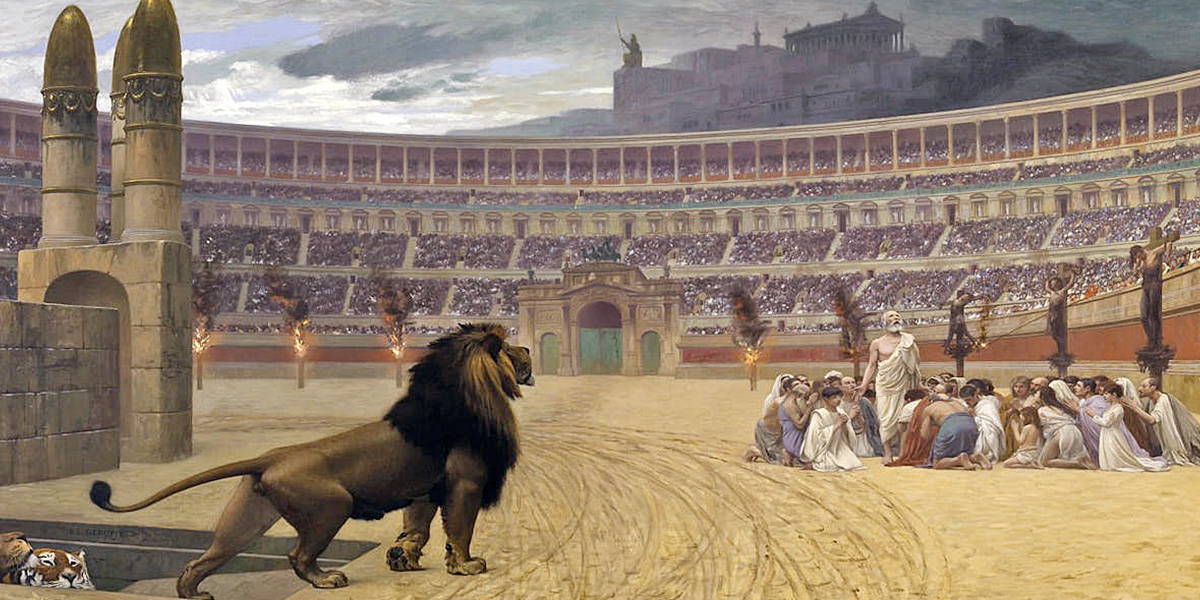
Dr. Stephen Presley, Associate Professor at Southern Baptist Theological Seminary, is the author of Cultural Sanctification: Engaging the World Like the Early Church. He spoke on this topic at the Mere Anglicanism conference held Jan. 22-24 in Charleston, S.C. Here is an abbreviated version of his talk.
Come back with me to third-century North Africa, where the Christian theologian Tertullian records the story about a soldier. The soldier was part of a legion that was receiving gifts bestowed upon them by the emperor in exchange for their loyalty and allegiance. At this ceremony, the soldiers were all given a small laurel crown to wear. But one Christian soldier refused because of his religious convictions. He removed the crown off his head and held it instead.
And this act seemed to symbolize the Christian conviction of honour for the emperor, but allegiance to God alone. Tertullian tells us that the soldier’s uncrowned head stood out among the throng of soldiers. They mocked and threatened him and reported him to the tribune. The tribune asked the Christian soldier, “Why are you so different in your dress?” The soldier explained that his religious convictions would not permit him to wear such a symbol of adoration to the emperor. He was willing to serve the empire, but he drew the line at imperial worship.
But in the tribune’s mind, refusing to wear the emperor’s crown was tantamount to treason against the paganism that united the empire. This disrespect would not be tolerated. They arrested him and condemned him to prison, where he likely died. The episode is clearly a flashpoint in the early Christian community, which is why Tertullian entitled his letter, On the Crown.
Not all the Christians appreciated the soldier’s actions. Why does this soldier make such trouble for us Christians over a trivial matter of dress? Why must he be so inconsiderate and rash and act as if he were anxious to die?
While some Christians thought the soldier’s act was selfish and put Christians at risk, Tertullian wrote to defend him. Scripture does not permit Christians to wear the emperor’s crown. The only crown Tertullian finds in Scripture is the crown of righteousness that the Christians receive [in heaven], a crown they actually take off and lay at the feet of their Saviour.
That incident exemplifies what Christians were facing living in a pagan society in the early Church. If we swap out the time, location and people, that story could be told today in so many parts of our world.
Now I want to make two key arguments. First, that the ancient world has come back to us in so many ways, and I want to show that the early Church is as relevant as ever for thinking about cultural engagement.
Caught between the emerging diversity of religious options, the ancient Christians were forced to ask: What are the fundamental assumptions that unite us? What are our first principles? By the second century, Rome was a ferment of religious choice. You could believe anything or nothing. You could put your trust in astrologers or snake charmers, prophets or magicians. You could take your pick from half a dozen creation myths, several varieties of resurrection. Or, if you belong to the educated elite, you could read the poetry of Lucretius or subscribe to a materialist view of the universe.
In short, it was a time when anything goes. And the weirdest, most frenzied creations of the mind jostle with the most beautiful visions and most inspiring spiritual challenges. It’s hard to think of any period quite like it until now. Or citing Carl Trueman at the end of The Rise and Triumph of the Modern Self: “In the second century, the church was a marginalized sect within a dominant pluralist society. This is where we are today.”
But the early Church can encourage and inspire us because at some point we might be asked, “Will you wear the crown?”
I want to explain a fourfold approach to cultural engagement that I found in the early Church: catechesis, citizenship, cultivating leaders and celebrating hope. In my mind, these four actually map pretty well onto Peter’s words in 1 Peter 2: 17: “Honour everyone, love the brotherhood, fear God, honour the emperor.”
First, catechesis. This is the heart of cultural engagement. There is no cultural engagement without being formed in the teachings of the scriptures and embodying them in your communities.
In the second century, the Bishop of Lyon, Irenaeus, wrote a little catechetical manual called The Demonstration of the Apostolic Preaching. Since man is a living being composed of body and soul, it is fitting to be formed both in morality and doctrine, body and soul. “For what use is it,” Irenaeus writes, “to know the truth in words and to defile the body by performing evil deeds? What profit can come from the wholeness of the body if truth is not in the soul? For these, rejoice together, join forces and lead man to the presence of God.”
If you want to see what is truly beautiful, you find a person and you find a community that is living according to the doctrine and the morality of God’s revelation. There you find true beauty on display for the world to see. The fathers also knew that catechesis was not going to be easy. Formation takes time. It’s not instantaneous. And there’s syncretism that’s always lurking, taking things of the culture and polluting the truth of the scriptures.
I recognize that even among the faithful, Christians will not always agree about prudential decisions of how these things work out in the public square. . But the first step is to find some essentials upon which we agree – basic Christian doctrine and morality.
Second, what is the content of early Christian catechesis? What did they give to new members? They gave them doctrine, morality and liturgical instruction. First, doctrine was about teaching the story of the Bible and the basic convictions of the Church or what the Church called the rule of faith. Augustine, in his work called On the Catechizing of the Uninstructed, says that the first thing you do with the new catechumen is sit down and tell them the story of the Bible: begin with God created the heavens, the earth, and then tell them the story down to the present age.
This is exactly what Augustine does in the second half of The City of God. He begins as Rome is collapsing, as is being pillaged. Augustine steps back and says, “Let’s look at the story of God’s work of salvation.” In the second century, Irenaeus’s catechetic manual does the exact same thing. In the New Testament, you can see it in Stephen’s sermon in Acts 7. Hebrews 11 and 12 actually tell the whole story of creation to the coming Kingdom of God.
In my latest book, Biblical Theology and the Life of the Early Church, I open with a story of entering the church of Saint Germain in Paris. In the nave are a series of frescoes that tell the biblical story. It was so beautiful. It was Christ’s life from his birth all the way to his ascension. And every moment of Christ’s life was tied to an Old Testament scene. I found myself worshiping in the midst of the beautiful story of God, and I found myself in it. Then I walked around the church and found myself staring at the grave of René Descartes. And I thought about the tension that that church embodies: the story of salvation versus the dualism that paved the way for an expressive individualism that will come later. And I immediately left Descartes’ grave and sat back down in the nave and stared at the story of God.
Not only did the early Church hand [new converts] the story of God, they gave them a rule of faith. This was a basic summary of the church’s teaching that was confessed at baptism. You stood before the community of faith and said, “This is what I believe.” And in a world of religious diversity, the rule of faith brought clarity on the essential principles and convictions of the faith. The rule of faith emerged out of scripture, Matthew 28: 19. And it paved the way for the Apostles’ and Nicene Creeds. The rule of faith became, to use Charles Taylor’s phrase, the “social imaginary,” the way they perceived their social existence.
They also needed moral instruction. In the early Church, there was something called a two-ways tradition. That language comes from Jeremiah or the Sermon on the Mount. Broad is the way that leads to destruction. Narrow is the way that leads to life. Listen to these words of a second-century text called the Didache, the earliest church manual we have: “There are two ways, a way of life and a way of death, and a great difference between them. The way of life is this, love God who made you, love your neighbour as yourself. Bless those who curse you. Pray for your enemies. Fast for those who persecute you. For what reward is there if you love only those who love you?... Abstain from fleshy and worldly lust. If someone gives you a blow on the right cheek, turn to him the other also.”
These are the kinds of imperatives that help the church navigate the pagan world around them.
The last and final piece of catechesis is liturgy. The early Church understood they needed a vision of life that orders one’s day, one’s week, one’s month, one’s year. Baptism and the Lord’s Supper become essential and distinctively Christian sacraments. Listen to the words of Justin Martyr, a second-century father, who gives us this early description of the church’s liturgy: “The wealthy among us help the needy, and we all keep together. On a day called Sunday, all who live in the cities gather in one place, and the memoirs of the Apostles are read with the prophets, as long as time permits, and then the pastor verbally instructs us to imitate these good things. Then we rise together and pray. When our prayer is ended, bread and wine are brought out. And then all who are well to do and willing give what each think fit for the orphans, the widows, for those who are sick.”
This was actually written to a pagan audience to explain to them: Look at this incredible and beautiful community. This is what we do. We love one another. If you want to find true community, you find it in the church. In his book The Rise and Triumph of the Modern Self, Trueman explains why the church grew. He concludes it was because the religion’s particular doctrines permitted Christianity to be among the most sweeping and successful revitalization movements in history. And it wasn’t just the doctrines, but it’s the way the doctrines took on flesh. So, what does catechesis or discipleship look like in your life?
The second peg of early Christian cultural engagement is citizenship. In Augustine’s classic definition, we are citizens of the city of God, embedded in the city of man, trying to figure out how to live. We have a rightly ordered love: love of God, love of neighbour, love of country. And the early Church knew that this ordering made them better citizens because they were actually free to love, free to serve, free to give.
Christians are not distinguished from the rest of humanity by country, language or custom. They live in Greek and barbarian cities – wherever God has placed them. They follow the local customs of food and of dress. The Epistle of Diognetus states: “They [Christians] live in their own countries, but only as aliens; they participate in everything as citizens, and endure everything as foreigners.” They marry like everyone else, and they have children, but they don’t expose their offspring [to the elements to die]. They share their food, but not their wives. They have a particular morality, a particular sexual morality that holds them fast. They are in the flesh, but they don’t live according to the flesh. They live on earth, but their citizenship is in heaven. They obey established laws; by their private lives they transcend those laws. They love everyone, and by everyone, they are persecuted.
To sum it up, what the soul is to the body, the church is to the world. The church in the second century was small and insignificant yet God was at work through them. The church is not just another cultural institution like a philosophical school or a civic club. The church is a gathering of those from every walk of life who have been formed by the gospel of Jesus Christ, saved and redeemed and sealed for resurrection. There are so many wonderful accounts in the early church of how the church changes lives. Just listen to this second-century apologist: “Look at the church. We who formerly delighted in fornication, now embrace chastity. We who used to dabble in magical arts, now dedicate ourselves to God. We who valued wealth above all things, now bring what we have to common stock.”
You want to see beauty and goodness? Look to the church. That is where God is at work. You can hear these early Christians saying, “Listen up, Rome, we are your best citizens. We are the best people like leaven working through dough.” The examples of Joseph and Daniel are cited everywhere in the early Church. They became the models of cultural engagement in a pagan world. And notice neither of them are running or hiding, but they’re living faithfully. And others see it and the two are elevated to positions of authority, power and influence.
On the Apostolic Tradition, which was an interview between a deacon and a new convert, the text says, “If you are interested in the church, but you are a pimp or a procurer of prostitutes, you should desist or be rejected.” Sculptors were instructed not to make idols. Those vocations that involve sexual immorality, pagan religious officials, gladiatorial games, they had to be abandoned if one wished to be a convert. [Today] what do you discern as the right Christian path in your particular profession?
Number three, we need virtuous leaders all across our institutions. I’ve written about the rise of the Christian intellectual in the early church. The second and third centuries are called the Age of the Apologists, because so many Christian intellectuals are emerging organically using the gifts God has given them to engage all levels of society. Justin started a catechetical school in Rome. Origen had one in Alexandria. Augustine is, of course, engaged with everyone in the ancient world. These Christian leaders engage philosophers, civic leaders, pagan intellectuals and everyone else. But they valued character over charisma. They valued virtue over vice. In On Pastoral Rule, which is one of the earliest manuals of church leadership, Gregory the Great writes, “No one does more harm in the church than he who has the rank and title of holiness and acts perversely.”
We need Christian leaders who are people of virtue, living out their faith in the public square, who will demonstrate faith and fortitude in the face of all kinds of criticism. In Mere Christianity, C. S. Lewis cites the virtue of fortitude as all of the virtues at their testing point.
In the first three centuries of the Church, there were no major revivals outside the Book of Acts. Instead, the church focused on building and shaping institutions. Throughout the 20th century, evangelicals have often focused on rallies and revivals. And these are good things. But to change the world, we need sustained, long-term stability that comes from influential leaders in positions of authority. I pray for revival. But I also pray for meaningful contributions from leaders.
Finally, like all the prophets, the times may be dark, but I try to end on hope. The virtue of hope was never divorced from the theological virtues of faith and love, but in the ancient world, the Christians gave a central place to the virtue of hope. Hope held them fast in moments of crisis.
In Rome, there was precious little hope. In his book, Pagans and Christians in the City, Stephen Smith argues Rome had a view of hope that was tied to political structures and national identity. He said in Homer, for example, the dominant image is that there is no life beyond this one. Fame in this life is your immortality. The best a man can hope for is to kill gloriously and die gloriously so that your name will be sung by the bards.
But the early Church saw hope differently. They saw hope in the resurrection and in the life of the world to come. What surprised me about the early Church was that they lived in hope. Every action was lived with this expectation that Christ was going to come again in glory, to judge the living and the dead. I’ll end with this. I’ve stood at the amphitheatre in Lyon. I’ve looked at the grounds where martyrs gave their lives in 176 or 177 AD. [One witness wrote:] “We cannot accurately tell or describe the magnitude of the distress in this region…. They endured every shame and torture. They made light of their sufferings. They hurried on to Christ and they shouted, ‘The sufferings of the present moment are not worthy to be compared to the glory that will be revealed in us.’”
The secular age is upon us and paganism is making its resurgence. But take heart. We have been here before. The modern Church can learn a lot from the ancient one. The ancients, to be sure, were not perfect. There were plenty of saints and sinners to go around. But the church survived and even thrived in times like our own, and God was faithful through it all. Now, it is our turn. TAP
THE PSALMS flow all around us, in the Offices of Morning and Evening Prayer, in the Introits, Graduals, and preparatory prayers of the Eucharist. The Gospels and Epistles are shot through with the Psalms like so many rays of light. They exceed our capacity for attention.
continue reading
The first Christmas was a night of long journeys, closed doors, and unexpected visitors smelling of woodsmoke and sheep.
continue reading
AS WE WRAP up 2025, the TAP team is so grateful that you are reading our stories, sending us notes of encouragement, and helping us grow. Our switch to digital-only has gone more smoothly than expected, and we are doing our best to respond to those who have questions and concerns. We are excited to launch a digital campaign (soon!) to reach many more readers. And the new focus on our online platforms will allow us to update stories even more frequently than we had been doing in the past. As always, if you have thoughts about how we can better serve and encourage you, please email us at [email protected]. For technical and subscription issues, please email [email protected].
continue reading
IT IS A sobering season in Nigeria. On Feb. 4, Islamic extremists killed 177 villagers in Kwara State, mostly moderate Muslims, and 35 in Katsina State.
THE PSALMS flow all around us, in the Offices of Morning and Evening Prayer, in the Introits, Graduals, and preparatory prayers of the Eucharist. The Gospels and Epistles are shot through with the Psalms like so many rays of light. They exceed our capacity for attention.
Come back with me to third-century North Africa, where the Christian theologian Tertullian records the story about a soldier. The soldier was part of a legion that was receiving gifts bestowed upon them by the emperor in exchange for their loyalty and allegiance.

RT. REV. PAUL Idlout, the first Inuit bishop in the world, died on New Year's Eve at the age of 90.
Copyright © 2026 The Anglican Planet. All rights reserved