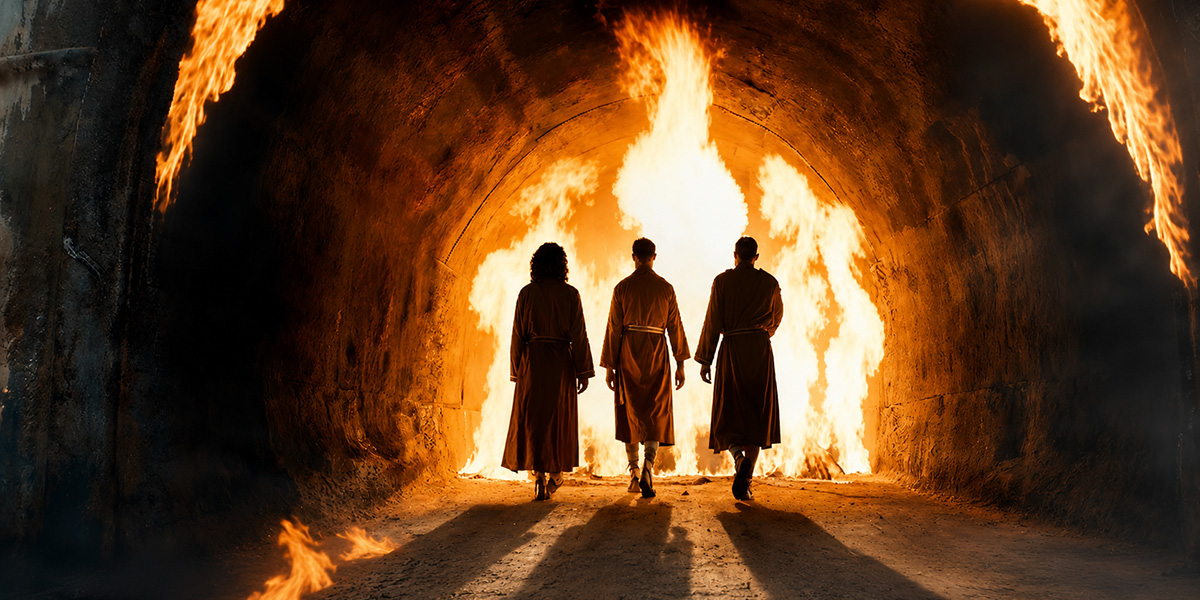
Description: The three men in the fire.
By Peter T. Chattaway
THERE have been quite a few Bible movies over the past few decades, but most of them have focused on the well-worn stories of Moses, David, Jesus, and the like. There have been virtually none – certainly none on the big screen – about the kings who lived after David, or about the Babylonian exile that brought an end to their kingdom.
That changes Sept. 18th when EKKL Entertainment releases Daniel and the Fiery Furnace, a movie about the prophet who lived in Babylon for the duration of that exile. The film is based primarily on the first three chapters of the book named after him, but it also brings in characters like Jeremiah and Habakkuk who lived through one of the most important – but least-filmed – periods in biblical history.
The film was written and directed by Matthew and Daniel Kooman, two Canadian brothers whose credits include documentaries like the assisted-dying exposé MAiD in Canada as well as the drama She Has a Name, about human trafficking in Thailand.
Daniel and the Fiery Furnace – which was filmed in India with many local actors—has an international feel reminiscent of some of the Koomans’ earlier works, but it also has epic visual effects and a stirring score by Tyler Michael Smith, whose father Michael W. Smith serves as a producer on the film.
The film stars Mena Massoud (a Canadian best-known for Disney’s live-action Aladdin) as Daniel, and Elijah Alexander (who plays the cynical Roman Atticus in The Chosen) as the Babylonian king Nebuchadnezzar.
I spoke to the Koomans – whose company, Unveil Studios, has addresses in B.C. and Alberta – about the film’s biblical inspiration, and how Daniel’s experience in Babylon can resonate for modern believers who have to participate in their own versions of Babylon without being subservient to them. What follows is an edited transcript of our conversation.
PTC: How did a couple of guys from Canada get to make a Bible epic, and in India of all places?
MK: It is a miracle, isn't it?
DK: Well, first, Peter – and you could do this too – you remortgage your house, and you put everything on the line and you are crazy enough to take the leap of faith to ask big time producers and actors to be a part of it, and then just see what happens!
PTC: Okay.
DK: I'm only saying that because it's true. But I think you have to be willing to take a leap of faith, right? You have to be willing to lose everything if you want to do something of value. And you have to really ask yourself, what do you value? Like, do I value the stuff in my life? Or do I value being a part of an eternal story? And we've really just been drawn to the book of Daniel.
You probably are aware of Daniel 12:4, which talks about a time where the scroll of Daniel will be opened: “People will be going to and fro, knowledge will greatly increase.” I believe we're in the time of the end that Daniel spoke of. So we're just part of a bigger story. And we're thankful to be able to be part of it.
PTC: There have been a lot of Bible movies lately, but most of them cover really well-known stories like Jesus, Moses and David. The book of Kings just sort of tends to get skipped over. So to have a film that begins with Jeremiah and Jehoiakim—right away, I'm interested. You’re treading ground that hasn't been trodden very much. Was that freeing? Daunting?
MK: One reason we moved towards just the first three chapters of Daniel was we needed to simplify the approach to the story, because it is big, it covers so much time. There are all these different kings, it's complicated breaking that down in one movie. And so our goal was to establish the world that this story lives in, and show the origin of [the prophet] Daniel as a young Daniel.
What excites us, though, is when you start studying scripture and looking at the timelines, you go, “Wow, these guys [Jeremiah, Habakkuk and Daniel] know each other, they have to. They're from the same kingdom, some even from the same families. They're going to know each other, they're going to know where everything came from.” So it was exciting to explore that world.
And as people who study the Bible, we think a lot of people will be excited about that. What we've heard, and what we really want, is that after people watch the movie, they go and open their Bible and start to ask questions—like what was happening then—and really challenge their faith, to strengthen their faith and to refine themselves in their faith.
PTC: The two main characters are interesting in very different ways. Nebuchadnezzar has to dance on this edge of being kind of sympathetic, because he is open to being impressed by God, but he's also a savage pagan who slaughters people—and he does throw Shadrach, Meshach and Abednego into the fiery furnace. So there's that interesting complexity to his character. I was also struck by the fact that you had Daniel actually involved in the making of the statue. How was that decision made?
DK: I think that there's a lot that can be discerned between the lines of the stories. As filmmakers, we have to imagine what happened between, you know, verses seven and nine, when sometimes years have passed between a comma or a period. One of the things that we did in great detail was study the chronology. If the Old Testament is two inches thick, a whole inch of the Bible is about the 70-year exile.
So we were trying to condense these different themes and ideas from that period, which is incredibly important. We have a theory as to why it's so important, because it has to do with the salvation of the Gentiles. If salvation is first to the Jew, and then to the Gentile, it was the beginning of the establishment of the salvation story for Gentiles. And that actually was what kept Daniel awake at night. He's like, “This is bigger than us.” And that shook him to the core; he was unable to eat and he fasted for days. And I think it should shake us as well, that God has a plan for his children.
Daniel was called to do impossible things, and so were Shadrach, Meshach and Abednego. I mean, it was impossible to go and serve, humbly and fully and with their whole heart, a king that had just – according to the Book of Jeremiah—smashed babies against the wall of Jerusalem. And some of this we had to do delicately and gently, because this is a story that we want people to experience, but it's incredibly violent, it's incredibly challenging what they went through. And then they went with humility and served the king of Babylon.
And Babylon in the worldview of the Hebrew culture was hell. I mean, that was like going into hell—and going into the fiery furnace was like going to hell inside of hell. And so you have these incredibly powerful themes.
Well, who shows up when you're in your greatest trial, if you're submitted fully and humbly? According to the prophet Isaiah – who they had the scroll of, and they studied – they would pass through the fire and not be burned (Isaiah 43:2), if they were refined as sons, right? And I think that those themes were just incredible.
And so, even participating in the making of the statue, it's like, we have to participate in the Babylon of our age, but are we subservient to it? Are we worshiping it? No. And they didn't have to go and contradict the law of their day to build something that they were instructed to do. But they wouldn't bow to it, they wouldn't worship a false idol. And so it actually served as a beautiful setup of a challenge for their characters to go, “You know, we're in Babylon here.”
Daniel had these plots and all of these things thickening around him, and he still stayed true, and he still stood firm in his faith. So there were things that were not on the page, but they could have been, and we really wrestled with that and depicted those things when we felt it served the story and the character as well.
PTC: I was also intrigued by the way Nebuchadnezzar has an interest in Jewish culture, which Daniel uses against him. When Nebuchadnezzar hears the interpretation of his dream, he immediately turns it into something that might benefit him, by asking if the eternal king will be someone from his lineage.
MK: He's worldly, right? I find that we kind of relate more to King Nebuchadnezzar. We want to emulate Daniel, but we relate to Nebuchadnezzar, and that's kind of more of our walk in this world, trying to break from this worldly self and attach to the kingdom side. How do we do that? I think we all wrestle with that, and that's something that I hope people can relate to and experience in the movie.
PTC: Are you thinking sequel? And if so, will Mena still be playing Daniel if Daniel's, like, 70 years older [when the lion’s den story happens]?
DK: We can't speak to all the contractual details, but the dream, of course, is to work with the great Mena Massoud and Elijah Alexander on future and continued parts of the story.
PTC: Are we going to see Nebuchadnezzar eating grass?
MK: That’s the plan! (Laughs.)
DK: Can’t wait for that.
For a list of Canadian theatres showing the film see: https://unveil.substack.com/p/canada-tickets-to-daniel-and-the
STANLEY Hauerwas once said, “In a hundred years, if Christians are known as a strange group of people who don’t kill their children and don’t kill the elderly, we will have done a great thing… If we can just be a disciplined enough community, who through the worship of God has discovered that we are ready to be hospitable to new life and life that is suffering,…that is a political alternative that otherwise the world will not have.”
continue reading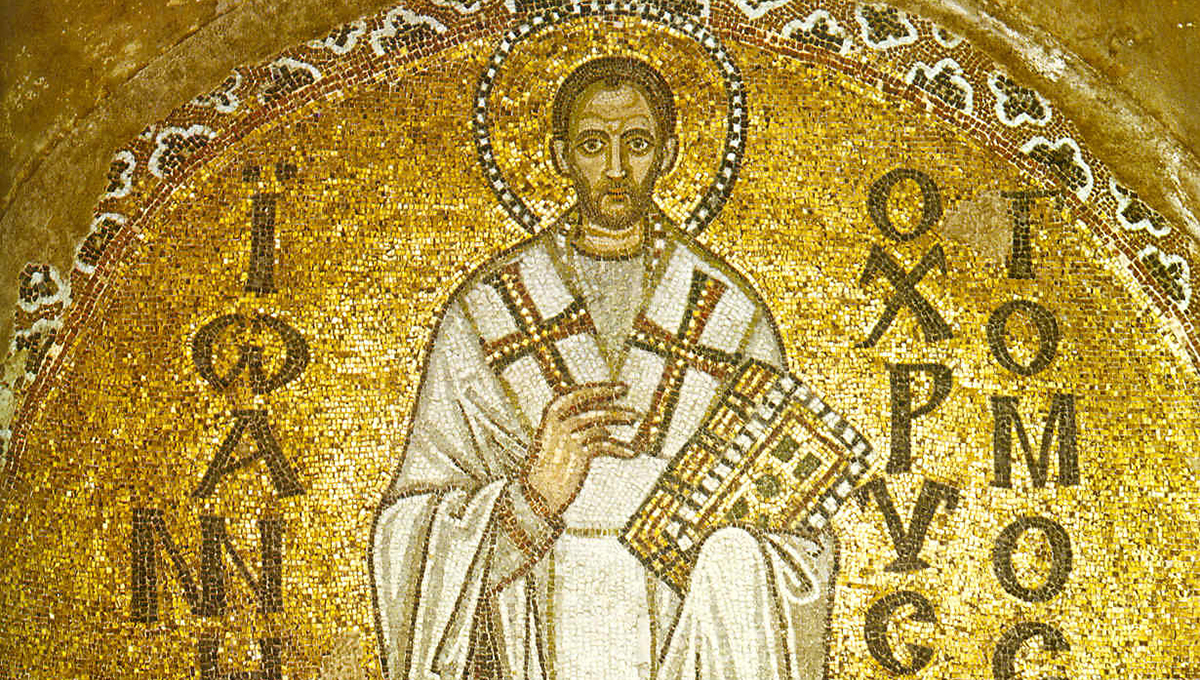
IN THE FOURTH century, in the region we now know as Turkey, there lived a pastor named John. Although his life was relatively short (he died at the age of 58) he has had an enormous impact on the Christian church. John was incredibly gifted, intense, and deeply serious about his faith. Not long after his conversion, he withdrew from society to live as a hermit for several years. He allegedly spent two full years doing nothing but memorizing the Bible while standing up. It was a rigorous discipline; he hardly slept, and his health was permanently damaged by the ordeal.
continue reading
ONCE when a friend and I were having coffee and chatting about hell, as friends do, and I grew increasingly squeamish at the topic, as one does, my friend surprised me by saying: “Why would someone bother sharing the gospel, if they weren’t thinking about saving someone from going to hell?”
continue reading
THERE have been quite a few Bible movies over the past few decades, but most of them have focused on the well-worn stories of Moses, David, Jesus, and the like. There have been virtually none – certainly none on the big screen – about the kings who lived after David, or about the Babylonian exile that brought an end to their kingdom.

THE Anglican Church of Canada’s Council of General Synod has released Pastoral Liturgies at the Time of Death in Contexts of Medically Assisted Dying, the denomination’s first publication on the topic since Faith Seeking Understanding(2024). That earlier collection, presented as a resource for discussion, offered a range of perspectives on euthanasia, including serious reservations and outright opposition. Its editorial stance was neutral, aiming to help Canadian Anglicans think through the ethical and practical complexities of MAiD.
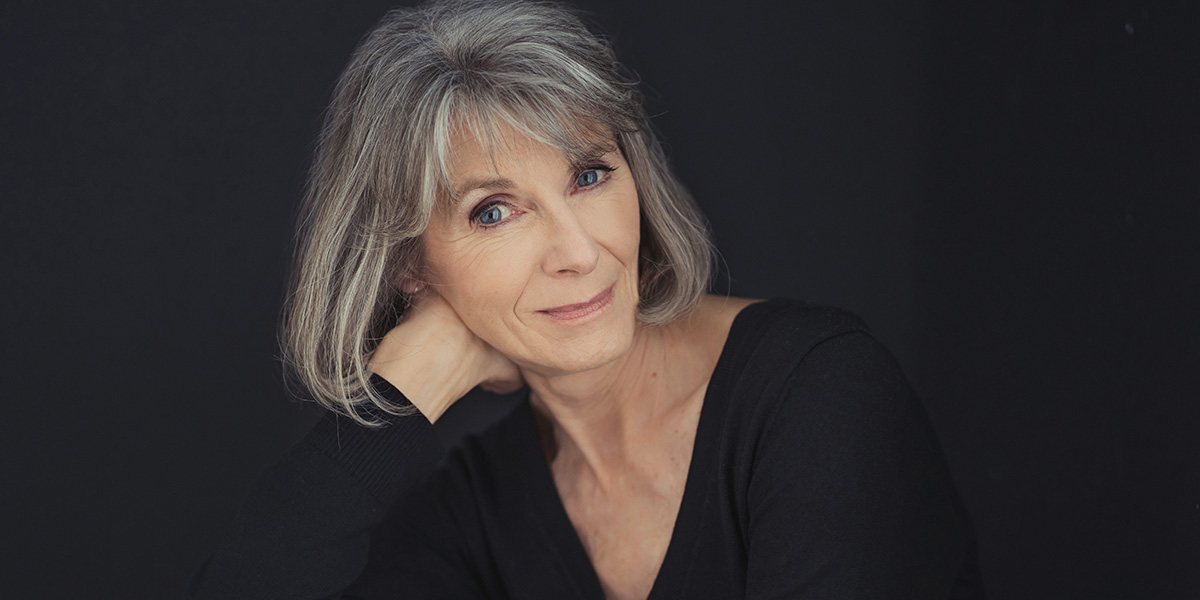
Judith Snowdon is an accomplished Canadian composer and arranger of choral, instrumental and worship music. For more than three decades she has received commissions from choirs as well as awards for her work. The Royal Conservatory of Music and the Canadian National Conservatory of Music have published many of her piano pieces for their students, while several of her hymns have appeared in denominational hymnals. Sue Careless asked the New Brunswick Anglican more about her musical journey.
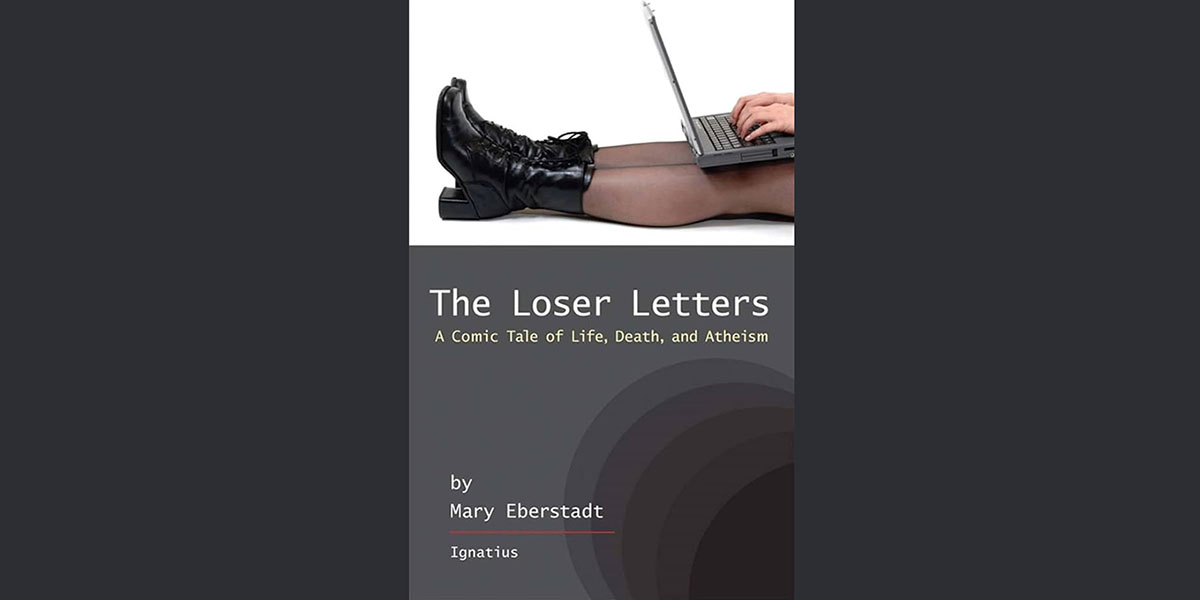
IT IS 84 years since C.S. Lewis published The Screwtape Letters: Letters from a Senior to a Junior Devil. The year was 1942, the middle of the Second World War, when victory for the free world was by no means certain. It quickly became a wartime bestseller.
Copyright © 2026 The Anglican Planet. All rights reserved